
The primitive man had to use his muscle power to carry out different works in his attempt of obtaining the necessities of life. The demand for more power and the scarcity of man power and the ready availability of natural resources like wind, water, etc., might have formed the reason why the ancient man turned his attention to the utilization of these resources as sources of power; thus originated the early prime movers namely wind mill and water wheel.
Principle of wind mill:
Wind flow is created as an effect of solar heat. Winds are caused due to the absorption of solar energy on the earth surface and the rotation of earth about its own axis and around the sun. because of this, alternate heating and cooling occurs and difference in pressure is obtained and the air movement is caused.
The flowing wind which has kinetic energy is used to rotate the wind turbine which is also known as wind mill. Although wind mills have been used for more than a dozen centuries for pumping water and grinding grains, interest in large scale power generation had developed over the past 50 years.
The earth’s atmosphere is thus a marvelous solar driven heat engine. It is estimated that roughly 10 million MW of energy is continuously available in the earth’s winds.
Types of winds mills
Wind mills are classified as
Horizontal axis wind mills are further classified as single-bladed, double-bladed and multi-bladed types.
Horizontal axis wind mill with double blade rotor:
In the horizontal axis single blade type, the blade is of propeller type with counter weight arrangement. The double blade type gives a better performance than the single blade type.
 In the double-blade type, the blade has thick cross section of an aerofoil. At the tip of the blade, the velocity is about six times the wind velocity. The blade is set at right angles to the direction of the wind. Ideally the blades should be twisted, but because of construction difficulties this is not always achieved.
The blade rotor drives a generator through a gear box. It is mounted on a bed plate attached on the top of the tower.
Blade material: the blades are made from aluminum or sheet metal. Not a single large wind turbine – generator with metal blades has operated for longer than one year without a blade failure. The suitable material required is a major problem in developing wind mills of higher power generation capacity.
With rotor, the tower is also subjected to the wind loads which may cause serious damage. Hence the structure of the tower should be so designed to withstand the wind load.
The best sites for the wind energy are found off-shore and sea coast. The second best sites are in mountains. The lowest level of wind energy is found in plains, where values are generally three or four times lower than that at the coast.
Multiblade rotor:
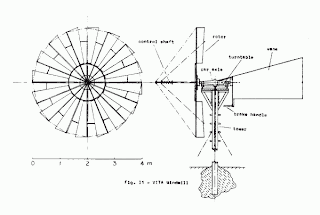
It is shown in image below. Rotors with more than two blades will produce high power.
Sail type blades:
It is of recent origin. The blade surface is made from cloth, nylon or plastic arranged as sail wings. There is also variation in the number of sails used.
The horizontal axis types generally have better performance than vertical types. They are mainly used for power generation and pumping water. The biggest wind mill erected for power generation is of 2500kW capacity in U.S.A.
Advantages of Wind Power Generation:
Disadvantages of Wind Power Generation:
Read more...
Principle of wind mill:
Wind flow is created as an effect of solar heat. Winds are caused due to the absorption of solar energy on the earth surface and the rotation of earth about its own axis and around the sun. because of this, alternate heating and cooling occurs and difference in pressure is obtained and the air movement is caused.
The flowing wind which has kinetic energy is used to rotate the wind turbine which is also known as wind mill. Although wind mills have been used for more than a dozen centuries for pumping water and grinding grains, interest in large scale power generation had developed over the past 50 years.
The earth’s atmosphere is thus a marvelous solar driven heat engine. It is estimated that roughly 10 million MW of energy is continuously available in the earth’s winds.
Types of winds mills
Wind mills are classified as
- Horizontal axis type and
- Vertical axis type, Depending on their axis of rotation.
Horizontal axis wind mills are further classified as single-bladed, double-bladed and multi-bladed types.
Horizontal axis wind mill with double blade rotor:
In the horizontal axis single blade type, the blade is of propeller type with counter weight arrangement. The double blade type gives a better performance than the single blade type.
 In the double-blade type, the blade has thick cross section of an aerofoil. At the tip of the blade, the velocity is about six times the wind velocity. The blade is set at right angles to the direction of the wind. Ideally the blades should be twisted, but because of construction difficulties this is not always achieved.
The blade rotor drives a generator through a gear box. It is mounted on a bed plate attached on the top of the tower.
Blade material: the blades are made from aluminum or sheet metal. Not a single large wind turbine – generator with metal blades has operated for longer than one year without a blade failure. The suitable material required is a major problem in developing wind mills of higher power generation capacity.
With rotor, the tower is also subjected to the wind loads which may cause serious damage. Hence the structure of the tower should be so designed to withstand the wind load.
The best sites for the wind energy are found off-shore and sea coast. The second best sites are in mountains. The lowest level of wind energy is found in plains, where values are generally three or four times lower than that at the coast.
Multiblade rotor:
It is shown in image below. Rotors with more than two blades will produce high power.

Sail type blades:
It is of recent origin. The blade surface is made from cloth, nylon or plastic arranged as sail wings. There is also variation in the number of sails used.
The horizontal axis types generally have better performance than vertical types. They are mainly used for power generation and pumping water. The biggest wind mill erected for power generation is of 2500kW capacity in U.S.A.
Advantages of Wind Power Generation:
- The wind energy is a renewable source of energy. It is free and inexhaustible.
- The power requirements for irrigation, lighting and small industrial units can be fulfilled with the use of wind energy. Power generation on large scale using wind energy is not yet so successful, but the small wind mills will play a vital role in the present condition of power shortage.
- It does not need transportation.
- Like all forms of solar energy, wind power systems are non-polluting.
Disadvantages of Wind Power Generation:
- Wind velocity is fluctuating which makes the complications in designing a wind power plant.
- Some form of storage of wind energy is essential to maintain a constant supply of power.
- The wind is a very hazardous, treacherous and unpredictable source of energy. Blowing in strong gusts from varying directions causing hurricanes, the wind may smash the whole plant within no time. To avoid this, special and costly designs and controls are always required.
- It is considered suitable and economical to generate power on a small scale of order of 2 MW.
- Power production cost with the present technology available may not compete with the conventional power generating systems. This is because, 1000s of units are required to provide the power output of one fossil-fueled plant.
- Wind energy systems are noisy in operation. A large unit can be heard many kilometers away.


